Table of Contents
- ARB Corporation Ltd: Company Overview and History
- ARB 4×4 Accessories and Product Range
- ARB Store Locations and Dealer Network
- ARB Product Fitment: How to Check Compatibility
- ARB Corporation ASX:ARB: Share Price and Financial Performance
- ARB vs Other Automotive Accessory Manufacturers
- Design, Manufacturing, and Distribution Strategy
- Conclusion: What ARB Corporation Ltd Means for 4WD Owners and Investors
- Frequently Asked Questions
Last Updated: October 10, 2026
ARB Corporation Ltd: Company Overview and History
ARB Corporation Ltd is an Australian manufacturer and distributor of four-wheel-drive accessories, vehicle equipment and light commercial vehicle products, listed on the ASX under the ticker ARB. This DriveGear guide covers what the company does, how its stores and dealer network operate, how to check product fitment, and what the ASX:ARB share price tells investors.
Its reputation rests on a simple idea: build gear that survives outback conditions, then sell it through a network that knows how to fit it.
ARB 4×4 Accessories and Product Range
ARB 4×4 accessories cover protection, recovery, storage and touring equipment for four-wheel drives and light commercial vehicles, split into gear that protects the vehicle and gear that makes it more useful on a trip.
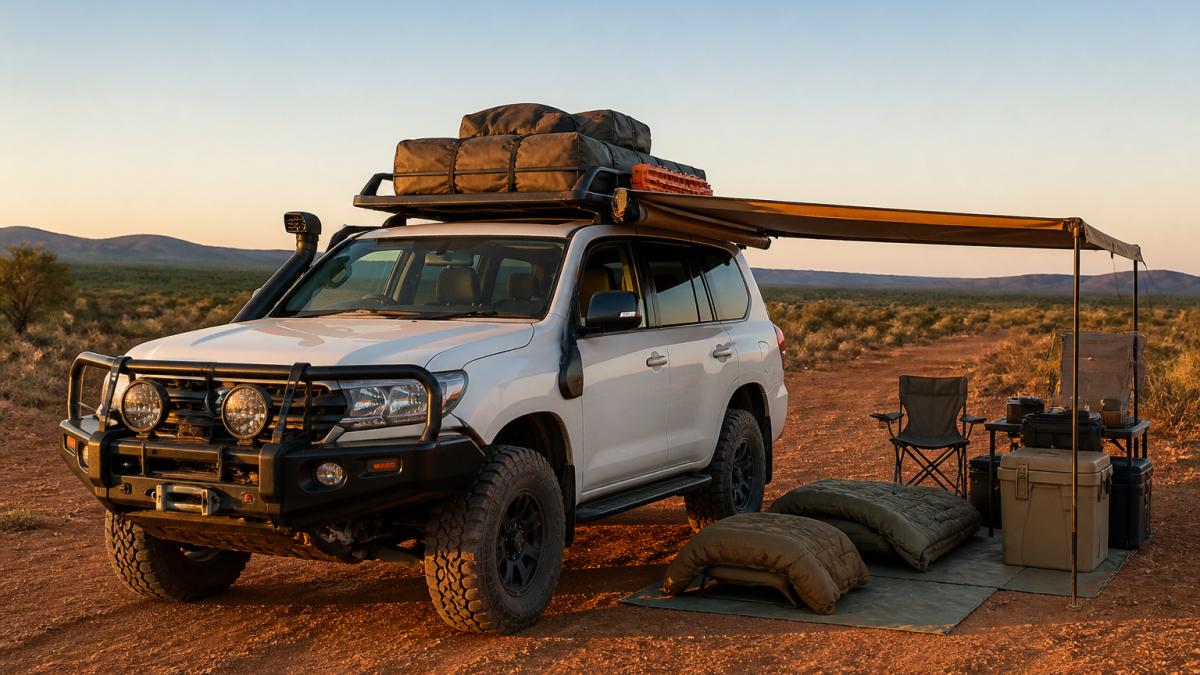
Bull bars, side steps, roof racks and canopies sit in the first group; recovery gear, dual battery systems, air compressors, fridges and drawers in the second.
Four-Wheel-Drive and Off-Road Equipment
Recovery gear is where ARB built much of its following. Snatch straps, recovery tracks, winches and air compressors are what most four-wheel drivers buy first, because a vehicle that cannot recover itself is a liability on any serious track.
A common mistake is buying recovery gear before understanding how it will be rated and stored. Match every strap and shackle to your vehicle’s weight, and keep it accessible rather than buried under luggage.
Light Commercial Vehicle and Aftermarket Accessories
Light commercial vehicles have become a major part of the accessory market. Tradies and fleet operators want trays, canopies, ladder racks and drawer systems that work as hard as the vehicle does.
Here the aftermarket accessory market differs from the general motor vehicle accessories trade: a ute buyer is solving a work problem, so durability matters more than finish.
ARB Store Locations and Dealer Network
ARB store locations span company-owned stores in major centres and a wider dealer network of independent stockists and authorised fitters elsewhere.
That structure matters: bull bars, canopies and roof racks often need professional fitting, and the dealer network provides installation, warranty support and advice.
Outside a major centre, check what your nearest stockist can actually fit versus what they can only order in, not every dealer does full installation.
Before you commit to a fitment booking, ask the dealer which products they stock locally and which are special order. Special-order items can add weeks to a build, and that is the most common reason a trip gets delayed.
ARB Product Fitment: How to Check Compatibility
ARB product fitment depends on your vehicle’s make and model, its build year, and whether factory options change mounting points, bull bars can differ between trim levels of the same model year.
Check using your vehicle’s compliance plate and VIN, not a photo of a similar car; accessory catalogues are organised by model code for a reason.
Here is how we would approach a fitment check:
- Record your vehicle’s make, model, year and variant from the compliance plate
- Note any factory bull bar, tow bar or sensor package already fitted
- Confirm whether your vehicle has parking sensors or cameras that interact with the accessory
- Check the manufacturer’s fitment listing for your exact model code
- Ask the fitter to confirm in writing before you pay a deposit
The step most people skip is number three: modern vehicles increasingly have sensors and cameras built into bumpers, and a bar that fits the model may still interfere with them.
ARB Corporation ASX:ARB: Share Price and Financial Performance
For investors, ARB Corporation is an ASX-listed business with a long record of paying dividends and funding growth largely from its own earnings.
The ASX company announcements for ARB Corporation publish the primary financial disclosures, and the Australian Securities and Investments Commission’s investor guidance explains what those disclosures must contain.
What most summaries miss is that ARB is two businesses wearing one ticker: the operating company, designing, manufacturing and distributing four-wheel-drive accessories, and the listed security, whose price reflects how the market expects that company to perform.
How to Read the Financials Like an Analyst
Rather than memorising a share price, work through the same sequence a professional would use when the annual report lands:
- Revenue split by segment. ARB reports across its retail, wholesale and export operations. Watch which segment is growing fastest, because a shift toward exports changes the risk profile of the whole business.
- Gross margin trend. A manufacturer that designs and makes its own product should hold a steadier margin than an importer-led competitor. A falling margin is a signal that discounting or input costs are biting.
- Operating cash flow versus reported profit. A business that converts profit into cash consistently is funding its own growth. A widening gap between the two is worth investigating.
- Inventory and working capital. Accessory businesses carry a lot of stock. Rising inventory relative to sales can mean demand is softening before it shows up in the profit line.
- Dividend payout ratio. Compare dividends paid against earnings per share. A payout ratio that creeps toward or beyond 100% is a warning that the dividend is being funded from the balance sheet rather than from profit.
- Capital expenditure. ARB has historically invested in its own manufacturing footprint. Capex tells you whether management is building for the next decade or milking the current one.
Revenue, Earnings, and Dividend History
Revenue and earnings come from two engines: domestic retail and wholesale, and export distribution. The export side has grown in importance, so currency movements and overseas demand now affect results alongside local trading conditions.
Dividend history is what long-term holders watch most closely. A company that has funded dividends through downturns says something about its balance sheet, though past payments never guarantee future ones.
Valuation and Investment Risks
Valuation for a business like ARB rests on earnings quality, brand strength and growth prospects. The main risks:
- Discretionary spending exposure. Accessories are a discretionary purchase. When household budgets tighten, a bull bar or roof rack is one of the first big-ticket items deferred.
- Export and currency risk. Overseas revenue is exposed to currency movements and to the economic conditions of the markets ARB sells into.
- Competitive margin pressure. Importer-led brands and general retailers compete on price, which caps how much ARB can charge for comparable products.
None of these are reasons to avoid the stock. They should shape how much you are willing to pay for it, and the questions you put to the company’s own disclosures before deciding.
The operating business and the listed security are not the same thing. A brand you trust as a customer is not automatically a bargain as a shareholder, the price you pay for the earnings is what determines your return.
ARB vs Other Automotive Accessory Manufacturers
ARB Corporation competes with large accessory manufacturers, importer-led brands and general automotive retailers. The honest comparison comes down to three trade-offs: how much engineering sits behind the product, how much fitment support comes with it, and what you pay for that support.
| Factor | ARB-style manufacturer | Importer-led brands | General retailers |
|---|---|---|---|
| Product quality | Consistent, engineered for local conditions | Varies by supplier | Varies by range |
| Fitment support | Dealer network with fitting expertise | Limited | Usually none |
| Price | Higher | Lower | Lowest |
| Warranty support | Local, established process | Depends on importer | Store-level |
| Best for | Serious touring and work vehicles | Budget builds | Basic accessories |
What most comparisons miss is that the price gap is not purely brand markup: local design, testing and fitting support cost money, and that is what you are paying for.
How the Competitive Set Actually Breaks Down
The accessory market is at least four markets, and ARB competes differently in each:
- Premium local manufacturers. Businesses that design and build their own product for harsh conditions, sell through a fitted dealer network, and compete on durability and warranty rather than price. This is where ARB sits, and the competitive set is small because the capital cost of local design and tooling is high.
- Importer-led accessory brands. Companies that source product from overseas suppliers and sell through general retail and online channels. They compete on price and range breadth, and their fitment support is usually limited to what the retailer can offer.
- General automotive retailers. Large chains that stock a broad range of accessories alongside parts, servicing and car care. They compete on convenience and foot traffic, not on specialist fitment.
Scale, Segments and Where the Money Is Made
A useful way to compare accessory manufacturers is where each earns its revenue:
- Domestic retail and wholesale. Sales through company-owned stores and independent stockists. This is the segment most exposed to local consumer confidence and to the health of the tradie and touring markets.
- Export distribution. Sales into overseas markets through distributors and partners. This segment is more exposed to currency movements and to the economic conditions of each destination market.
- Original equipment and fleet supply. Some manufacturers supply vehicle brands or fleet operators directly. This is higher-volume, lower-margin work that can smooth factory utilisation but dilute overall margins.
A heavy domestic retail skew is more sensitive to local conditions; a heavy export skew to currency and overseas markets. ARB’s mix across these segments is the most important thing to understand when comparing it with a pure importer or retailer.
The Trade-Offs That Actually Matter to a Buyer
When deciding between a locally engineered bar and a cheaper imported one, the differences that show up over time are:
- Fit and finish. Locally developed product is usually designed against the actual vehicle, so panel gaps, sensor cut-outs and mounting points line up.
- Corrosion resistance. Coastal and outback conditions punish cheap coatings. The difference often only appears after a few years.
- Crash and airbag compatibility. A bar that has been engineered and tested for the specific vehicle is a different proposition from a universal fit.
- Spare parts availability. A local manufacturer can supply a replacement bracket or latch years later. An importer may have moved on to the next model.
- Warranty process. A local warranty claim is handled locally. An importer-backed claim can involve waiting on a supplier on the other side of the world.
If you are comparing two products and the price difference is large, ask what is different about the mounting system, the coating and the warranty process. Those three answers usually explain the gap better than the brand name does.
The practical conclusion is that there is no single ‘best’ manufacturer. There is a best manufacturer for your vehicle, your use case and your budget. A serious touring build and an occasional weekend accessory purchase are different problems, and they justify different answers.
Design, Manufacturing, and Distribution Strategy
ARB’s strategy runs from design through manufacture to distribution and sales, with product development driven by real use in harsh conditions.
That vertical approach is unusual in the aftermarket accessory market, where most competitors either design and outsource everything or import and rebadge.
For buyers, the upshot is straightforward: products tend to be consistent between stores, and spare parts and warranty support are easier to find years after purchase.
Do not assume a product is compatible just because it is listed for your model. Model-year changes, factory options and sensor packages regularly change mounting points, and a wrong fitment discovered after installation is expensive to reverse.
Conclusion: What ARB Corporation Ltd Means for 4WD Owners and Investors
ARB Corporation Ltd sits at an unusual intersection: a brand four-wheel drivers trust for durability, and a listed business investors follow for its dividend record and export growth. Whether you buy gear or shares, the same discipline applies, check the fitment, or the financials, before you commit.
At DriveGear, we stock many premium 4WD accessories and car care essentials, with fast delivery across the country, products sourced from trusted manufacturers, and a focus on quality and usability.
Frequently Asked Questions
Who owns ARB Corporation?
ARB Corporation Ltd is a publicly listed company on the Australian Securities Exchange under the ticker ASX:ARB. It is owned by its shareholders, which include institutional investors and retail investors. The company was founded in 1975 by Tony Brown and has grown from a small operation into a major manufacturer and distributor of 4×4 accessories. Its shares trade openly, so ownership changes daily based on market activity. For current major shareholders, check the company’s annual report or ASX announcements.
Is ARB Corporation listed on the ASX?
Yes, ARB Corporation Ltd is listed on the Australian Securities Exchange under the code ASX:ARB. The company has been publicly traded since 1987. Its share price, financial results, and dividend history are available through the ASX website and financial news platforms. Investors can buy and sell shares through a broker or online trading platform. The ASX listing means ARB must comply with Australian disclosure requirements, providing regular updates on revenue, earnings, and business activities.
How can I check whether an ARB product suits my vehicle?
ARB product fitment depends on your vehicle’s make, model, year, and variant. The most reliable way is to use ARB’s online fitment guide or visit an ARB store with your vehicle details. Staff can confirm whether a bull bar, roof rack, or suspension kit is compatible. You can also check the product label or packaging for specific vehicle listings. If buying online, enter your registration or VIN where prompted. Getting fitment right avoids returns and ensures safety.
Where can I find ARB 4×4 accessories and stores?
ARB 4×4 accessories are available through ARB’s own retail stores, authorised dealers, and online. ARB store locations are listed on the company’s website, with outlets in most Australian states and territories. Many independent 4WD shops also stock ARB products. For the full range, including vehicle-specific equipment, check the ARB website or contact your nearest store. If you prefer to shop online, DriveGear offers a curated selection of 4WD gear with fast Australia-wide delivery.