
Table of Contents
- Understand Your Vehicle’s Weight and Recovery Needs
- How to Calculate Winch Size for Your 4WD
- Synthetic Rope vs Steel Cable Winch: Which Is Right for You
- Electric vs Hydraulic Winch: Power and Performance
- 4WD Winch Mounting and Fitment: Installation Essentials
- Safe Recovery Procedure and Maintenance
- How to Choose a Winch: Key Decision Framework
- Frequently Asked Questions
Last Updated: October 11, 2026
Understand Your Vehicle’s Weight and Recovery Needs
Understanding how to choose a winch for a 4WD starts with one simple fact: you need to know what you’re pulling. Most people skip this step and buy based on price or brand reputation. That’s a mistake.
Your vehicle’s weight determines everything. Not the kerb weight you see in the manual, that’s the weight when empty.
Here’s why GVMR matters for winch selection: when you’re stuck, your winch pulls not just your vehicle’s weight but also the angle of the terrain and friction from mud or sand.
Common vehicle types and their typical GVMR ranges:
- Small SUVs: 2,000-2,500 kg
- Mid-size 4WD utes: 2,500-3,200 kg
- Large 4WD utes: 3,200-3,800 kg
- Dual-cab trucks: 3,500-4,500 kg
Start with your vehicle’s compliance plate, then calculate your actual loaded weight. Add passengers, fuel, recovery gear, and any cargo you typically carry. That’s your real-world pulling weight. Your winch capacity should exceed this by at least 50%.
How to Calculate Winch Size for Your 4WD
Gross Vehicle Mass Rating and Winch Capacity
Winch capacity is measured in kilograms of pulling force at the fairlead, the point where the cable or rope exits the winch drum. This is your baseline number.
But here’s where most guides get it wrong: rated capacity assumes a single line pull on flat ground. Real recovery is rarely flat. Mud adds friction. Sand shifts. Steep inclines multiply the force needed. That’s why the 1.5× safety margin exists.
Let’s work through an example. You own a mid-size 4WD ute with a GVMR of 3,000 kg. You carry camping gear, water, and sometimes passengers. Your loaded weight is roughly 3,200 kg.
Winch capacity categories to consider:
- 3,500-4,500 kg: Small SUVs, light recovery work
- 4,500-6,800 kg: Mid-size 4WDs, mixed terrain
- 6,800-9,000 kg: Large utes, heavy recovery, double-line pulls
- 9,000+ kg: Extreme terrain, commercial use
The key is matching capacity to your actual use, not your dreams. A daily commuter who occasionally goes off-road needs less capacity than someone tackling sand dunes every weekend.
Accounting for Terrain and Recovery Angles
Terrain changes everything. Flat, hard ground is forgiving. Mud, sand, and steep inclines demand more pulling power. When you’re on a slope, gravity works against you. The steeper the angle, the more force your winch must generate.
Recovery scenarios and their force multipliers:
- Flat, hard ground: 1× capacity needed
- Muddy terrain: 1.3-1.5× capacity needed
- Sandy terrain: 1.5-2× capacity needed
- Steep inclines (30+ degrees): 1.5-2.5× capacity needed
- Extreme angles (45+ degrees): 2-3× capacity needed
This is why terrain matters as much as vehicle weight. A 3,000 kg vehicle stuck in deep mud on a slope might require 6,000-7,500 kg of pulling force. Your winch needs to handle that.
Consider where you actually drive. Do you stick to graded tracks? A smaller capacity works. Do you explore remote areas with deep sand and rocky slopes? Go larger. There’s no penalty for oversizing, except cost and battery drain. But undersizing leaves you stuck.
At DriveGear, we ask customers about their typical terrain before recommending a winch. This conversation matters more than the spec sheet.
Synthetic Rope vs Steel Cable Winch: Which Is Right for You
Synthetic rope and steel cable perform the same job but with different trade-offs. Both attach to your winch drum and pull with equal force. The choice depends on your priorities.
Synthetic rope is lighter, safer, and easier to handle. It floats, so it won’t sink in water. It doesn’t rust. If the rope breaks under load, it doesn’t whip back like steel cable, it falls limp.
Steel cable is tougher against sharp rocks and rough terrain. It resists abrasion better than rope. It’s also cheaper.
Synthetic rope advantages:
- Lighter weight (easier on your vehicle’s suspension)
- Safer (no whip-back if it breaks)
- Floats in water
- More line capacity per drum
- No rust or corrosion
Steel cable advantages:
- Lower cost
- Better abrasion resistance
- Proven track record
- Easier to splice in the field
The real difference comes down to safety and convenience. If you’re recovering in rocky terrain or near people, synthetic rope is worth the extra cost.
Most customers choose synthetic rope for the safety benefits, especially if they’re new to recovery work. Experienced off-roaders often prefer steel cable for its durability in harsh conditions.
Electric vs Hydraulic Winch: Power and Performance
Electric winches dominate 4WD recovery because they’re simpler, cheaper, and easier to maintain. They run off your vehicle’s battery and alternator. Hydraulic winches draw power from your engine’s hydraulic system. Both work, but electric is the practical choice for most owners.
Electric winches are straightforward. You install them, connect them to your battery, and they’re ready. No special hydraulic lines to route. No fluid to monitor. When your battery is low, you know it immediately.
The trade-off is power delivery. Hydraulic winches provide steady pulling force regardless of battery voltage. Electric winches can slow down as your battery drains. In a long recovery, this matters. But for most single-line pulls, electric performance is plenty.
Electric winch benefits:
- Lower installation cost
- Simpler wiring (battery connection)
- Minimal maintenance
- Easy to troubleshoot
- Works with standard 4WD electrical systems
Hydraulic winch benefits:
- Consistent power output
- Better for extended use
- Preferred for heavy-duty commercial work
For a 4WD owner choosing their first winch, electric is the answer. It’s reliable, affordable, and proven. You’ll find electric winches on most recreational 4WDs across Australia.
4WD Winch Mounting and Fitment: Installation Essentials
Your winch is only as good as how it’s mounted. A poorly fitted winch can fail when you need it most. The mounting point must be strong enough to handle the full pulling force.
Check these before buying:
- Does your 4WD have a factory winch-ready bumper?
- Is an aftermarket winch bar available for your model?
- Can the mounting point handle your winch’s rated capacity?
- Is there clearance for the winch drum and rope/cable?
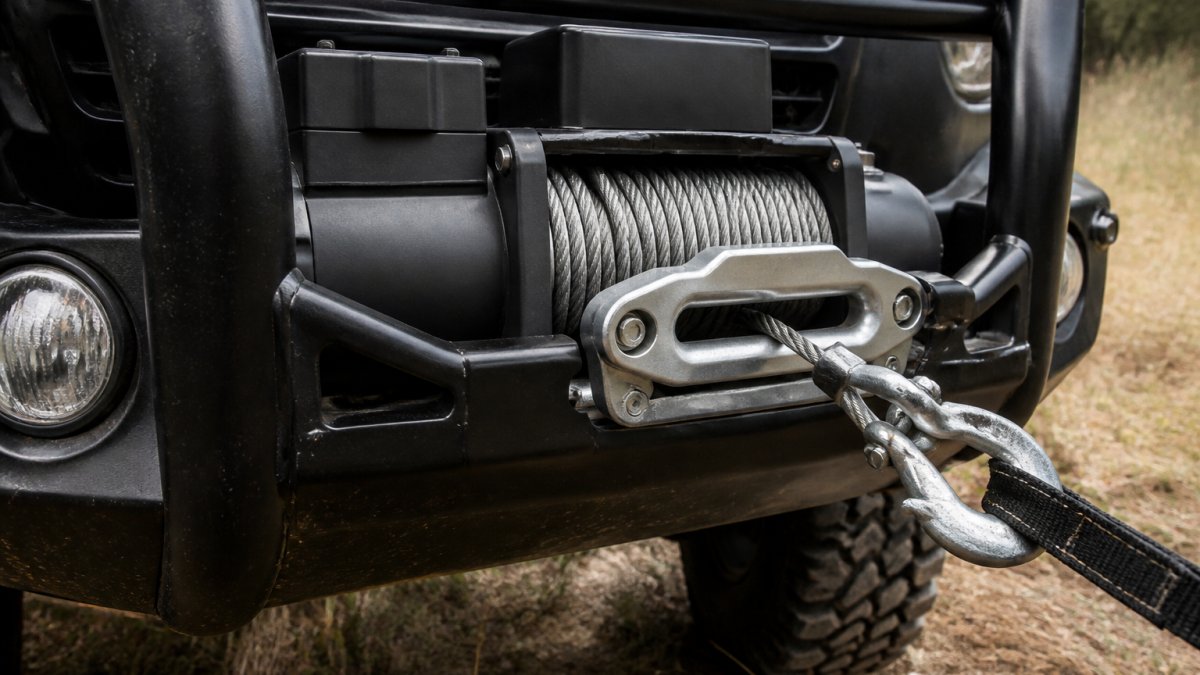
The fairlead guides your rope or cable smoothly off the drum. A poorly aligned fairlead causes the rope to fray or the cable to kink. It also reduces pulling efficiency.
Your recovery point is where the rope or cable attaches to the winch. This must be rated for the full pulling force. A weak recovery point is a safety hazard. Always use a proper shackle or recovery point designed for your winch capacity.
Electrical System Compatibility and Wiring
Electric winches demand reliable power. Your vehicle’s battery and alternator must supply enough current without draining other systems. Most 4WDs have a 12-volt electrical system. Your winch will draw significant current during a pull, often 100-200 amps. If your battery is weak or your alternator is undersized, the winch will struggle.
Electrical requirements to check:
- Battery capacity (at least 100 amp-hours for reliable winching)
- Alternator output (150+ amps recommended for electric winches)
- Wiring gauge (heavy-duty cable, typically 4-6 gauge)
- Fuse or breaker protection (sized to winch amperage)
- Isolator switch (to prevent battery drain when winch is not in use)
A weak battery or alternator will cause your winch to operate slowly and may damage your vehicle’s electrical system. An upgrade might be necessary.
Proper wiring is non-negotiable. Undersized cable causes voltage drop, which reduces pulling power and generates heat. It’s a fire hazard. Have a qualified auto electrician install your winch if you’re not confident in your skills.
Recovery Points and Fairlead Selection
Your recovery point is where the rope or cable connects to the winch. It must be rated for your winch’s full capacity. A standard shackle rated for your winch capacity is the safe choice. Never improvise with hooks or carabiners that aren’t rated for the load.
The fairlead guides the rope or cable as it winds onto the drum. A misaligned fairlead causes the rope to bunch up or the cable to kink. This reduces efficiency and damages the rope or cable.
Fairlead types:
- Roller fairlead: smooth, suitable for rope and cable
- Hawse fairlead: compact, good for tight spaces
- Snatch block fairlead: allows double-line pulls for extra power
A snatch block is a separate pulley that doubles your pulling force by running the rope through it twice. This is useful when your winch capacity is marginal or when you need extra pulling power in extreme terrain. However, it requires a second anchor point and more setup time.
Safe Recovery Procedure and Maintenance
Recovery is dangerous if you don’t follow proper procedure. The rope or cable is under enormous tension. If it breaks, it can whip back and cause serious injury. Always follow these steps:
Safe recovery steps:
- Clear the area of people and obstacles
- Wear heavy gloves and eye protection
- Keep bystanders at least 10 metres away
- Ensure the anchor point is solid and rated for the load
- Check the rope or cable for damage before winching
- Operate the winch slowly and smoothly
- Stop immediately if you feel unusual resistance
- Never winch at full speed for extended periods
Maintenance keeps your winch reliable. After each use, inspect the rope or cable for damage, fraying, or kinks. Clean mud and sand from the drum. Check that all bolts are tight. Store your winch in a dry place if possible.
Regular maintenance checklist:
- Inspect rope or cable monthly
- Clean the winch after muddy recoveries
- Check mounting bolts quarterly
- Test the winch under light load every season
- Replace damaged rope or cable immediately
- Lubricate the drum and gears annually
Synthetic rope lasts 2-3 years with regular use. Steel cable can last 5+ years if maintained. The fairlead and shackles should last the life of your vehicle if you use them correctly.
How to Choose a Winch: Key Decision Framework
Learning how to choose a winch for a 4WD comes down to five questions. Answer them honestly, and the right winch becomes obvious.
1. What is your vehicle’s GVMR?
This is your starting point. Multiply by 1.5 to get your minimum winch capacity. This number guides everything else.
2. Where do you actually drive?
Flat, graded tracks? Muddy terrain? Sand dunes? Rocky slopes? Terrain determines the safety margin you need.
3. How often will you use the winch?
Occasional recovery? Weekly off-road trips? Daily commuting with rare recovery? Frequent use favours durability.
4. Do you prioritise safety or cost?
Synthetic rope costs more but is safer. Steel cable is cheaper. Electric winches are simpler than hydraulic.
5. What’s your electrical system capacity?
Can your battery and alternator handle an electric winch?
Work through these questions before shopping. You’ll know exactly what you need.
Choosing a winch for your 4WD doesn’t have to be overwhelming. DriveGear is your premier destination for high-quality 4WD accessories, automotive tools, and car care essentials designed to elevate your driving experience.
Frequently Asked Questions
How do you calculate the right winch capacity for your vehicle?
Start with your vehicle’s gross vehicle mass rating (GVMR) and multiply by 1.5 to account for terrain angle and load shift during recovery. For a vehicle weighing 2,500 kg on flat terrain, a 4,000 kg rated winch provides adequate safety margin. On steep inclines or soft terrain like mud or sand, increase this multiplier to 2.0 or higher. Always check your vehicle’s specifications and consider the terrain where you’ll recover most often.
Is synthetic rope or steel cable better for a 4WD winch?
Synthetic rope is lighter, safer if the line breaks (no dangerous recoil), and easier to handle, making it ideal for regular off-road use and self-recovery. Steel cable is more durable in abrasive terrain and around sharp rocks, and it resists UV damage better in harsh conditions. For most 4WD owners balancing safety and durability, synthetic rope is the modern choice; steel cable suits extreme rocky terrain or professional recovery work.
What should you check before fitting a winch to a 4WD?
Verify your vehicle’s electrical system can handle the winch’s power draw (most require a dedicated battery and heavy-gauge wiring). Check that your bull bar or mounting point is rated for the winch’s weight and pulling force. Ensure you have a suitable recovery point on your 4WD and a fairlead that fits your bumper. Review your vehicle’s suspension and braking capacity to handle the added weight and recovery loads safely.
Do you need a winch for a 4WD?
A winch is not essential for casual 4WD driving on maintained tracks, but it becomes critical for remote recovery, self-recovery in mud or sand, and serious off-road touring where professional help is unavailable. Daily commuters rarely need one, while adventure seekers tackling challenging terrain benefit greatly from the safety and independence a winch provides. Consider your typical driving environment and how far you travel from help.